

Luxury fashion and design brands face a persistent tension: how do you create campaigns that drive measurable performance without diluting the prestige that defines your brand? Traditional performance marketing often relies on aggressive retargeting and discount-led tactics that erode exclusivity. Yet purely editorial storytelling, while beautiful, struggles to demonstrate ROI in boardrooms demanding data-driven results. This guide reveals how to bridge that gap, offering a comprehensive framework for executing performance-led campaigns that marry cinematic storytelling with conversion outcomes tailored to luxury's unique purchase cycles and audience expectations.
Table of Contents
- Key takeaways
- Understanding the problem and preparing your campaign
- Step-by-step guide to executing a performance-led campaign
- Measuring success and optimising performance without compromising prestige
- Key performance benchmarks and lessons from luxury campaigns
- How Good Over Evil can elevate your campaign performance
- FAQ
Key Takeaways
| Point | Details |
|---|---|
| Performance led campaigns | Combine cinematic editorial storytelling with conversion focused outcomes to drive measurable results without diluting luxury branding. |
| Precision targeting | Use behavioural data and postcode insights to reach affluent audiences more effectively than broad interest segments. |
| Quarter long measurement | Measure campaigns over a quarter to capture long purchase cycles and avoid misleading attribution. |
| Channel blends with AI | Leverage multi channel strategies across Meta, TikTok and Pinterest with AI driven tools to scale without diluting brand prestige. |
| Respect brand prestige | Avoid frequency heavy retargeting that erodes luxury perception and undermines exclusivity. |
Understanding the problem and preparing your campaign
Luxury brands operate within fundamentally different purchase dynamics than mass-market retailers. Long purchase cycles and brand equity protection define every strategic decision, with customers often researching and considering for months before committing to high-value purchases. This extended timeline demands campaign structures that nurture interest without appearing desperate or transactional. Discount-led approaches, whilst effective in fast fashion, actively harm luxury positioning by suggesting the brand lacks confidence in its inherent value.
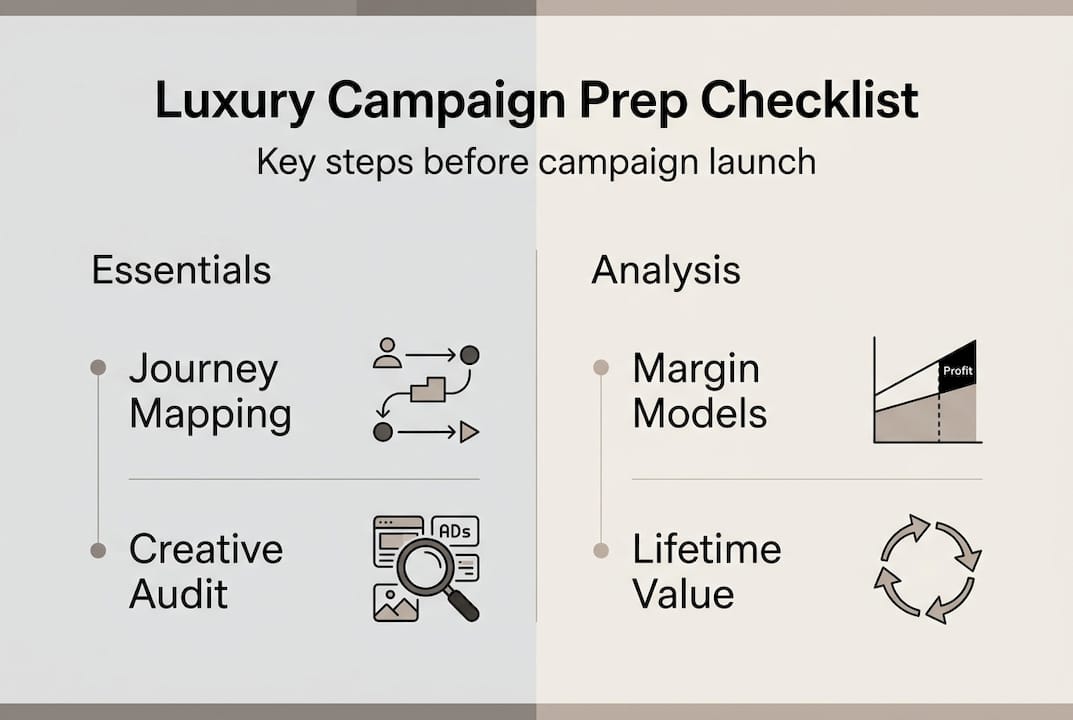
Preparing an effective campaign begins with mapping customer journeys that honour these nuances. You need to understand where your audience discovers aspirational content, how they validate quality and craftsmanship, and what emotional triggers ultimately convert consideration into purchase. This mapping informs creative briefs that prioritise immersive editorial-style content over direct selling. Think campaign films that establish cultural relevance and aesthetic codes before ever mentioning product features or pricing.
Setting realistic measurement frameworks proves equally critical during preparation. Traditional 7-day attribution windows capture only a fraction of luxury conversions, creating misleading performance data that undervalues awareness-building content. Instead, establish quarter-long tracking periods that align with actual purchase timelines. This longer view reveals how film production and creative direction at the funnel's top ultimately drives bottom-funnel conversions weeks or months later.
Pro Tip: Before launching any campaign, audit your existing creative library to identify which assets best represent brand storytelling versus performance-optimised formats. Luxury campaigns need both, deployed strategically across funnel stages rather than mixed haphazardly.
Your preparation checklist should include defining contribution margin models that account for lifetime customer value, not just first-purchase metrics. Luxury customers who connect with your brand narrative often become repeat purchasers and advocates, making their true value far higher than initial ROAS suggests. Build this understanding into campaign budgets and success criteria from the outset.
Step-by-step guide to executing a performance-led campaign
Executing a performance-led luxury campaign requires a sequenced approach that respects brand storytelling whilst optimising for measurable outcomes. The framework below provides a proven structure adapted from luxury brand marketing strategies that balance creative excellence with conversion focus.
Phase one: immersive awareness
- Create 60-90 second campaign films that establish aesthetic codes and cultural positioning without explicit selling
- Deploy these across Instagram feed, Stories, and Reels targeting high-net-worth postcode segments and behavioural signals like luxury travel bookings or art gallery attendance
- Set frequency caps at 2-3 impressions per week to maintain mystique and avoid overexposure
- Track video completion rates and engagement metrics as leading indicators of narrative resonance
Phase two: proof and validation
- Develop carousel ads showcasing craftsmanship details, material provenance, and editorial placements that validate quality
- Target users who engaged with phase one content, expanding to lookalike audiences based on website visitors and email subscribers
- Introduce subtle product information and pricing for transparency without compromising aspiration
- Monitor click-through rates and time-on-site metrics to gauge consideration depth
Phase three: curated access
- Create retargeting campaigns offering exclusive previews, limited editions, or personalised consultations rather than discounts
- Limit frequency to once every 10-14 days to position your brand as selectively available, not desperate for sales
- Use dynamic product ads only for users who browsed specific items, maintaining relevance without broad retargeting
- Measure conversion rates and average order values against luxury benchmarks
| Campaign phase | Primary objective | Key metrics | Typical duration |
|---|---|---|---|
| Immersive awareness | Cultural positioning | Video completion rate, engagement rate | 4-6 weeks |
| Proof and validation | Consideration building | Click-through rate, time on site | 3-4 weeks |
| Curated access | Conversion optimisation | Conversion rate, average order value | Ongoing |
Precision targeting separates effective luxury campaigns from wasteful broad approaches. Instead of targeting generic interests like "fashion" or "luxury goods", focus on behavioural signals that indicate genuine purchasing power and brand affinity. High-net-worth postcode data, combined with signals like private school attendance areas or luxury automotive ownership patterns, creates audiences far more likely to convert. Creative direction and performance marketing services specialising in luxury understand these targeting nuances deeply.

Maintaining narrative coherence across all three phases ensures your campaign feels like a unified brand experience rather than disconnected ads. Visual language, tone, and messaging should evolve naturally from awareness to conversion without jarring shifts. This coherence reinforces brand identity whilst guiding customers smoothly through their purchase journey.
Pro Tip: Test multiple creative variations within each phase, but limit tests to 2-3 versions maximum. Excessive testing fragments your budget and prevents any single narrative from building sufficient momentum to resonate with luxury audiences who value consistency and curation.
Measuring success and optimising performance without compromising prestige
Luxury campaign measurement demands fundamentally different approaches than mass-market performance marketing. Incrementality testing beyond short attribution windows reveals true campaign impact by comparing results against control groups over extended periods. This methodology accounts for the reality that luxury purchases rarely happen within days of first exposure, making traditional last-click attribution dangerously misleading.
Quarter-long attribution windows align measurement with actual luxury purchase cycles. When you track conversions across 90 days rather than 7, you capture customers who discovered your brand through awareness content, researched extensively, and eventually purchased weeks later. This longer view typically reveals that top-of-funnel storytelling drives 40-60% more conversions than short-window attribution suggests, validating investment in cinematic campaign films.
Comparing measurement models highlights critical differences in how you evaluate success:
| Measurement approach | Timeframe | Best for | Limitations |
|---|---|---|---|
| Last-click attribution | 7-30 days | Direct response tactics | Undervalues awareness and consideration content |
| Multi-touch attribution | 30-60 days | Mid-funnel optimisation | Still too short for luxury cycles |
| Incrementality testing | 90+ days | True campaign impact | Requires control groups and sophisticated tracking |
| Contribution margin models | Lifetime value | Long-term brand building | Harder to isolate individual campaign effects |
Retargeting frequency management proves essential for maintaining brand prestige whilst optimising performance. Heavy retargeting creates perceptions of desperation that directly contradict luxury positioning. Cap retargeting at 1-2 impressions per fortnight, focusing on genuinely valuable content like new collection previews or personalised recommendations rather than generic "complete your purchase" messages. This restraint actually improves conversion rates amongst luxury audiences who interpret selective visibility as confirmation of exclusivity.
Channel optimisation requires balancing platform strengths with brand-safe controls. Meta's detailed targeting and creative testing capabilities make it foundational for luxury campaigns, whilst TikTok's creator partnerships enable cultural relevance amongst younger affluent audiences. Pinterest Performance+ offers AI-driven optimisation with visual discovery behaviours that align naturally with luxury consideration. Blend these channels strategically, using film production and creative direction services to maintain consistent creative quality across platforms.
Analyse ROAS, CPA, and conversion rates against luxury-specific benchmarks rather than generic e-commerce standards. Luxury campaigns typically achieve ROAS between 2.5x and 6x with CPA figures 3-5 times higher than mass-market categories, reflecting higher product values and longer sales cycles. Context matters enormously when evaluating whether your 4x ROAS represents success or underperformance.
Pro Tip: Create a custom dashboard that combines platform metrics with offline sales data, as luxury purchases often begin online but complete in-store or through personal shopping services. This holistic view prevents undervaluing digital campaigns that drive showroom traffic.
Key performance benchmarks and lessons from luxury campaigns
Empirical results from luxury brand campaigns reveal what's achievable when performance marketing respects brand positioning. Case studies demonstrate ROAS of up to 6x alongside substantial CPA reductions, proving that cinematic storytelling and data-driven optimisation can coexist successfully.
Pip Pop Post, a luxury stationery brand, achieved 6x ROAS through sequenced campaigns that led with editorial-style product photography before introducing targeted offers. Their approach prioritised visual storytelling that positioned products as design objects worthy of aspiration, then used precision retargeting to convert engaged audiences. CPA decreased by 45% compared to previous direct-response tactics that lacked narrative context.
Prada's TikTok campaigns demonstrate how luxury brands can leverage creator partnerships whilst maintaining brand control. By collaborating with fashion-focused creators who already embodied Prada's aesthetic codes, the brand achieved 3.2x ROAS with engagement rates 4x higher than standard luxury benchmarks. The key lay in selecting creators whose existing content naturally aligned with Prada's visual language, requiring minimal brand direction.
| Brand | Primary channel | ROAS achieved | CPA change | Key success factor |
|---|---|---|---|---|
| Pip Pop Post | Meta, Pinterest | 6.0x | -45% | Editorial storytelling before offers |
| Prada | TikTok, Instagram | 3.2x | -28% | Aligned creator partnerships |
| Luxury footwear brand | Meta, Google | 4.8x | -35% | Postcode-based precision targeting |
| Designer homewares | Pinterest Performance+ | 5.1x | -40% | AI-optimised visual discovery |
Channel performance varies significantly based on product category and target demographics. Instagram excels for brands leveraging cultural moments and lifestyle positioning, with Stories and Reels driving engagement rates 2-3x higher than feed posts. TikTok performs strongest for brands targeting affluent audiences under 40, particularly when creator content feels organic rather than overtly sponsored. Pinterest Performance+ delivers exceptional results for homewares and fashion accessories, where visual discovery behaviours naturally align with purchase intent.
Key lessons from successful luxury performance campaigns:
- Balance prestige and performance by sequencing narrative-led awareness before conversion-focused messaging
- Measure across quarter-long windows to capture true campaign impact beyond short attribution periods
- Use custom audience targeting based on behavioural signals and postcode data rather than broad interest categories
- Cap retargeting frequency aggressively to maintain perceived exclusivity and avoid overexposure
- Invest in creative quality that matches brand positioning, as production value directly influences luxury audience trust
- Test incrementally within proven frameworks rather than radical experiments that risk brand dilution
These benchmarks and lessons provide realistic expectations for luxury performance campaigns. The data confirms that respecting brand positioning whilst optimising for measurable outcomes isn't just possible but actually improves results compared to tactics borrowed from mass-market playbooks. Your campaigns can achieve both creative excellence and commercial performance when strategy acknowledges luxury's unique dynamics.
Ready to explore how these principles apply to your specific brand challenges? Request a consultation to discuss tailored approaches.
How Good Over Evil can elevate your campaign performance
Creating performance-led campaigns that honour luxury brand positioning requires specialised expertise spanning cinematic storytelling and data-driven optimisation. Good Over Evil sits precisely at this intersection, combining film production and creative direction with performance marketing services designed specifically for fashion, music, and design-focused brands.
Our approach blends editorial-quality campaign films with sequenced funnel strategies that drive measurable results without compromising brand prestige. We understand luxury purchase cycles, precision targeting methodologies, and the creative nuances that separate effective luxury campaigns from diluted mass-market tactics. Whether you need complete campaign development or strategic guidance to optimise existing efforts, our team brings proven frameworks adapted to your unique brand positioning and commercial objectives. Request a consultation to explore how we can elevate your next campaign.
FAQ
What is a performance-led campaign in luxury fashion?
A performance-led campaign combines data-driven marketing optimisation with cinematic storytelling to achieve measurable results whilst preserving brand prestige. It uses sequenced messaging that guides customers from awareness through consideration to conversion, with each stage designed for specific outcomes. This approach respects luxury purchase cycles and audience expectations, avoiding aggressive tactics that harm perceived exclusivity.
How can long purchase cycles be managed in campaign measurement?
Use quarter-long attribution windows that align with actual luxury purchase timelines rather than standard 7-day windows that capture only immediate conversions. Implement contribution margin models and incrementality testing to isolate true campaign impact over extended periods. This longer measurement view reveals how awareness content drives conversions weeks or months later, preventing undervaluation of top-funnel storytelling investments.
Why is maintaining brand prestige important in performance marketing?
Overexposure through heavy retargeting or discount-led tactics reduces perceived exclusivity and damages customer trust in luxury brands. Maintaining narrative coherence and curated access safeguards brand identity whilst still driving conversions through strategic, restrained engagement. Luxury audiences interpret selective visibility as confirmation of value, making prestige protection a performance enhancer rather than constraint.
Which platforms best support luxury performance campaigns?
Instagram excels for brand cultural moments and lifestyle positioning, with Stories and Reels driving strong engagement amongst affluent audiences. TikTok benefits from creator partnerships that feel organic whilst reaching younger luxury consumers. Pinterest Performance+ and Meta enable precise targeting that blends AI optimisation with brand-safe creative controls, making them foundational for luxury campaign structures across awareness and conversion stages.